
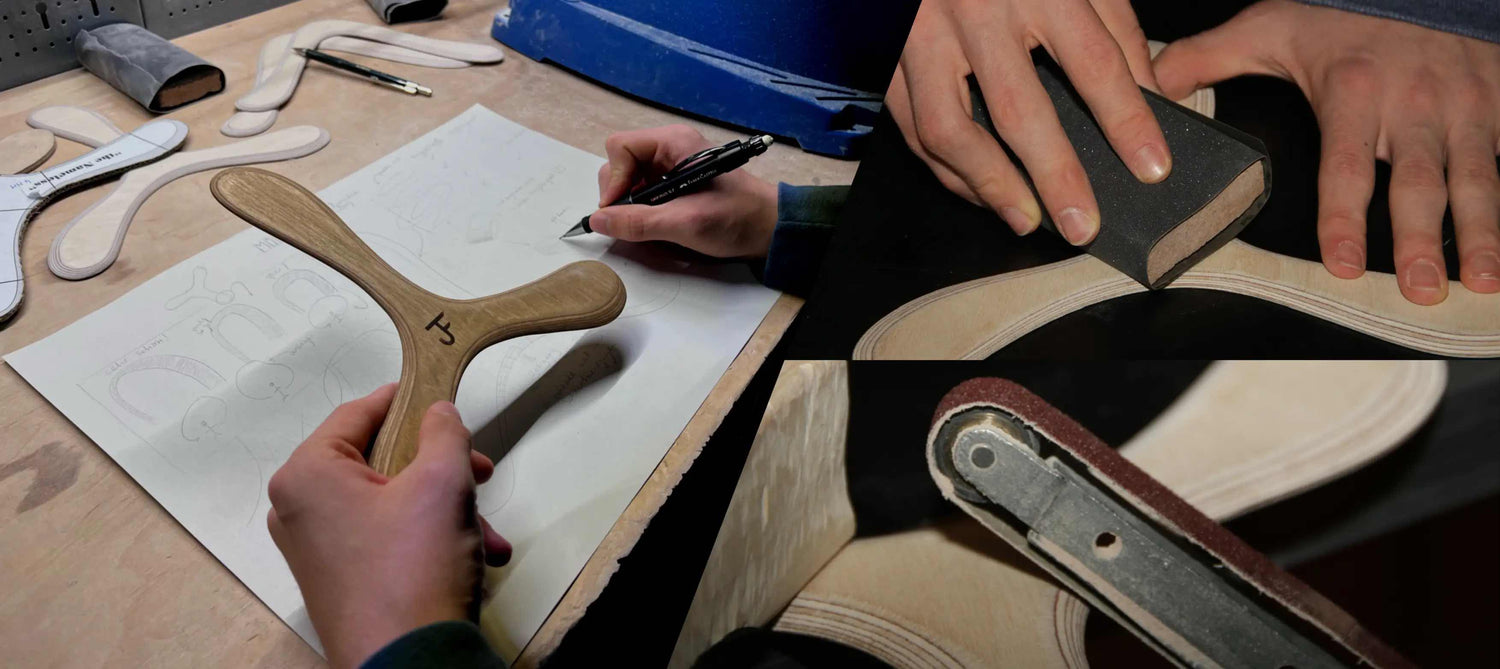
Making a boomerang might seem complicated at first glance, but with the right guide and materials, it's definitely doable. Of course, you're welcome to buy a boomerang from our shop, but building one yourself is also incredibly cool. For us, this first father-son boomerang building project years ago was ultimately the brilliant first step on the path to our father-son boomerang manufacturing business.
Here's a basic guide to help you get started – including the physics behind it, tuning tips for fine-tuning, and care instructions to ensure your homemade boomerang brings you joy for a long time.
What you need to build a boomerang
Boomerang blueprint
A good boomerang blueprint is key to success. You can find and download these plans online. If you can't find any, feel free to check the German Boomerang Club's website. They have a large number of different shapes that you can choose from based on your skills or simply what you like best. Also, note that there are different blueprints for left-handed and right-handed boomerangs.
Aircraft plywood
High-quality aircraft plywood is crucial for your boomerang's flight characteristics. It should be lightweight yet robust enough to withstand the forces of throwing. In any case, make sure it has as many layers as possible. Regular plywood from a hardware store is not particularly suitable; it's better to look on specialized model-building sites. For our boomerangs, we typically use 4 mm thick aircraft plywood with 7 layers. Although this is a bit more expensive, it's worth it to prevent the boomerang from breaking or getting damaged on landing.
Tools
You will need the following tools for your boomerang, which you probably already have at home or can get at any hardware store.
- File: For shaping and smoothing the wood.
- Sandpaper or sanding sponge: For finer work and smoothing the surface.
- Clamp: To securely fix the wood and work precisely. It's best to use a wooden clamp, protected with cork, so you don't damage the surface of your boomerang.
Protective coating
To protect your boomerang from the elements, it is advisable to coat it with a glaze, varnish, or oil. This not only extends its lifespan but also gives the boomerang an attractive appearance. If you want to do nature a favor, opt for an environmentally friendly glaze. For example, we use a natural oil, which is excellent for giving the boomerang a beautiful color and protecting it.
The physics behind it: Why does a boomerang fly back?
Before you grab a file, it's worth taking a quick look at the principle behind it – this will greatly help you with the sanding later, because you'll understand what's important.
A boomerang flies back because its wings have an asymmetrical profile, similar to an airplane wing: the top side is slightly curved, the bottom side is flatter. When thrown, the boomerang spins very quickly around its own axis – this creates a low-pressure area on the top side, generating lift, similar to an airplane wing.
Because the boomerang simultaneously moves forward and rotates, the speed of one wing (the one rotating upwards in the direction of flight) is higher than that of the other. This speed difference creates a lateral force that compels the boomerang into a curve – this interplay of angular momentum and uneven lift distribution is called the gyroscopic effect. The result: instead of flying straight, the boomerang describes a large curve and returns to you.
For your construction process, this specifically means: the curved top side and the flatter bottom side are not an optical detail, but the core of the flight characteristics. This is precisely what the next step in sanding aims for.
Steps to the Boomerang
You will then need to carry out the following steps to finally proudly hold your new boomerang in your hands. As I said, it sounds complicated at first, but it's definitely achievable.
1. Examine the boomerang blueprint carefully
Before you start building, it's important to thoroughly examine the boomerang blueprint. Understand exactly where you need to sand. Also, double-check that you have selected the correct blueprint, depending on whether you are right-handed or left-handed.
2. Prepare materials
Cut the pattern according to the blueprint and ensure you have everything necessary ready. This primarily means the aircraft plywood, the file if you're not working with a pre-made blank, a jigsaw or coping saw, and a clamp to secure the wood or blank to your workbench.
3. Producing the blank
Draw the exact outline of the boomerang onto the wood using the pattern. Secure the wood accordingly and use a jigsaw or coping saw to cut out the blank. Ensure good ventilation or extraction, as a lot of wood dust can be generated during the creation of the blank as well as in the subsequent steps.
4. Sanding the boomerang
Mark the exact areas to be sanded on the blank with a pencil. Then, use a file and sandpaper to shape the boomerang. Remember the asymmetrical profile we discussed earlier: the top side gets the curve, the bottom side remains flatter. If you follow the sanding pattern precisely, nothing should go wrong. It doesn't have to be perfect down to the last millimeter, but try to stick as closely as possible to the template.
5. Finishing touches
Refine the surface of your boomerang with fine sandpaper or a sanding sponge to ensure a smooth and aerodynamic finish. If you use extra fine sandpaper, the surface will become wonderfully soft and the boomerang will feel almost like a worry stone.
6. Protective coating
Apply a glaze, varnish, or even an oil to protect your boomerang from the elements and give it an attractive appearance. Then, let the boomerang dry according to the instructions on the package.
7. Be proud
You are now holding your first handmade boomerang in your hands, and you should be a little proud of that. Congratulations, you are now officially a boomerang builder!
Before the first flight
You've built your first boomerang, it's sanded, dried, and looks great. Now it's time to throw it for the first time.
Before your first flight, please be sure to go through detailed instructions and observe all safety warnings! This is really important to have a lot of fun and not accidentally endanger yourself or others.
If you need help on exactly how to throw a boomerang, feel free to check out our Guide to throwing a boomerang – there we describe step-by-step how it works, and our boomerang throwing tutorial on YouTube is also linked there.
Remember that practice makes perfect. Even if it doesn't come back the first time, don't get frustrated. Pay a little more attention to the wind and the launch angle, and it might work then.
Fine-tuning after the first test flight
Hardly any self-built boomerang flies perfectly on the very first try – that's completely normal, and that's where the boomerang builder differs from the boomerang master. Here are a few typical problems and how to fix them:
- The boomerang rises too sharply instead of flying in a curve: The angle of attack during the throw is usually too steep – throw a little more vertically on the next attempt.
- It doesn't quite come back, but lands sideways: Often, it helps to slightly (really minimally!) bend the wingtips or finely sand the edges on one side to change the balance.
- The flight seems unstable or wobbly: This is usually a sign of uneven sanding between the wings – compare both wings precisely again and compensate for small differences with fine sanding.
Always proceed in small steps: sand a little, test, sand a little again. Large corrections all at once usually lead to new problems rather than solutions.
Care and Repair
Even a lovingly crafted boomerang will show signs of wear over time – this is normal and usually has little effect on its flight characteristics. If you still want to freshen it up:
- Small scratches or dents: Carefully smooth with fine sandpaper until the surface is even again
- Faded protective layer: Simply apply a new layer of glaze, oil, or varnish, just like during the original construction
- Small splinters on the edges: Carefully sand until the edge is smooth again – for larger damage to the wing profile, it's worth checking if the flight characteristics are still correct before throwing again
Frequent Questions
Which wood is best suited for building a boomerang? Multi-layered aircraft plywood with as many thin layers as possible – the more layers, the more stable and break-resistant the boomerang will be. Regular hardware store plywood is usually too unstable.
How long does it take to build a boomerang yourself? Depending on your experience and care during sanding, you should plan a whole afternoon for your first project – rushing is more of a hindrance here, especially with the fine sanding.
Is it worth building it yourself, or should I rather buy a boomerang? That depends entirely on you! Building it yourself is a great project, especially with children or as a weekend project – for us, it was even the starting point of the entire manufacturing business. However, if you want a reliably flying, optimized model from the start, you'll find boomerangs in our shop whose shapes were developed together with boomerang world champion Heinz-Willi Dammers – for all those who don't want to tinker themselves but want to start throwing right away.
We hope you have as much fun building a boomerang as we do and hope the guide was useful to you. If so, feel free to leave a comment. Of course, also if there's something we should go into more detail about.
Have fun building and throwing your own boomerang!
Jürgen & Felix
Had enough of reading, now you want to try it yourself? Then take a look at our Online Shop and choose the right boomerang for you.
Images: Self-made, ideogram, DBC


Leave a comment
All comments are moderated before being published.
This site is protected by hCaptcha and the hCaptcha Privacy Policy and Terms of Service apply.